

Where the Product Stands Today
ーWhere are you in product development?
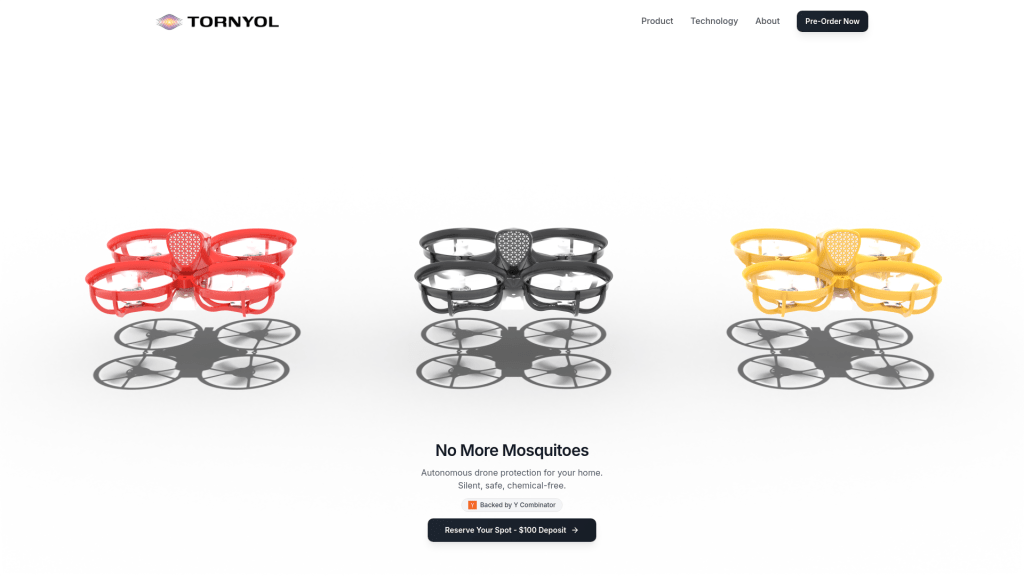
Most of the pieces are already working, just in isolation. We have a detector that works on its own bench, a drone that can fly, and the autonomy stack working. We’ve done tracking and interception in simulation. What we haven’t done yet is put it all together and run the whole thing end-to-end on a single drone. That integration is always where the hardest work lives in deep tech. We’re making good progress, and based on our roadmap we think we can ship in 2026.
ーLet’s talk about pricing and margins. You’re technically a hardware company, but your economics sound almost like software.
Our business actually has a pretty nice structure. The value a customer gets from having a mosquito-free yard is huge. Especially for people with big gardens in hot climates, the difference between “mosquitoes everywhere” and “no mosquitoes” is worth thousands of dollars in quality of life.
On the other hand, the drones we use are very cheap, since they’re based on small toy drones. The real value of our product is in the software: the detection, the control, the autonomy. So in a sense we’re a hardware company with software-like margins. Our current pre-order price is around $1,100, and we’ll probably go a bit higher over time, especially for late adopters. Even with actuators and other physical parts adding to the bill of materials, we have enough pricing power to protect our margins.
ーWho are your first customers, and how does your go-to-market plan evolve from there?
Our initial focus is on individuals in the southern parts of the EU and the US: southern France, Spain, Italy, the southern US. People who actually suffer from mosquitoes and have the purchasing power to buy an early, relatively expensive product. We want to get the first drones into their hands as early adopters and testers.
Once we figure out the economics of scale, we want to bring the price down a lot, ideally to drones that cost around $100 and cover a much larger area. At that point, it becomes realistic to sell not just to consumers but to entire countries, including very poor ones. That’s when it really becomes a mass-market product. But we have to earn the right to get there by first making the high-end version work properly.
ーHow about competition? Is anyone else doing what you’re doing?
We do have competitors, but no one else is building mosquito-killing drones. Our real competition today is a lot more ordinary. For example, in places like Texas, there are local businesses spraying insecticide across fields and properties. That’s who we’re actually competing with right now.
ーSmall drones are usually very vulnerable to strong winds. How do you handle outdoor conditions like wind?
Here’s something interesting: mosquitoes themselves hate wind. When it’s windy, they don’t fly. Same with heavy rain. So the conditions where we need our drones to operate are also the conditions where small drones are easier to fly.
On top of that, we use reinforcement learning to train our control agents. We simulate wind in the training environment and let the agents figure out how to behave in it. As long as the task is physically possible, meaning the drone has enough thrust and sensing to push against the wind and feel that it’s being pushed, the RL agents usually learn the right behavior on their own.
ーWhere do you see the company in 5 to 10 years?
In five years, I want us to have products shipping everywhere, generating real revenue, and already making a visible dent in mosquito populations. On a ten-year timescale, what I really hope is that we’ve had a visible impact on malaria and other mosquito-borne diseases. That’s the big goal of the company.
And if we can do that, I’d love to take the same technology and move into agriculture, replacing insecticides that are killing insects with harmful chemicals today. There are a lot of invasive species around the world that people currently fight with pesticides, and we want to be the replacement for that. So our top two priorities are simple: replace insecticides, and get rid of malaria.
Message to MBA Students and Aspiring Founders
ーFinally, do you have a message for IESE students who are thinking about starting a company, or for people who spend a lot of time coming up with ideas but never acting on them?
My message is simple. Build your business. Try to get clients. Don’t try to impress people. Don’t post on LinkedIn unless it directly helps your business. You’re at a business school, so actually sell things, build a business, do the work. That’s it.
Tornyol Official Website
https://tornyol.com